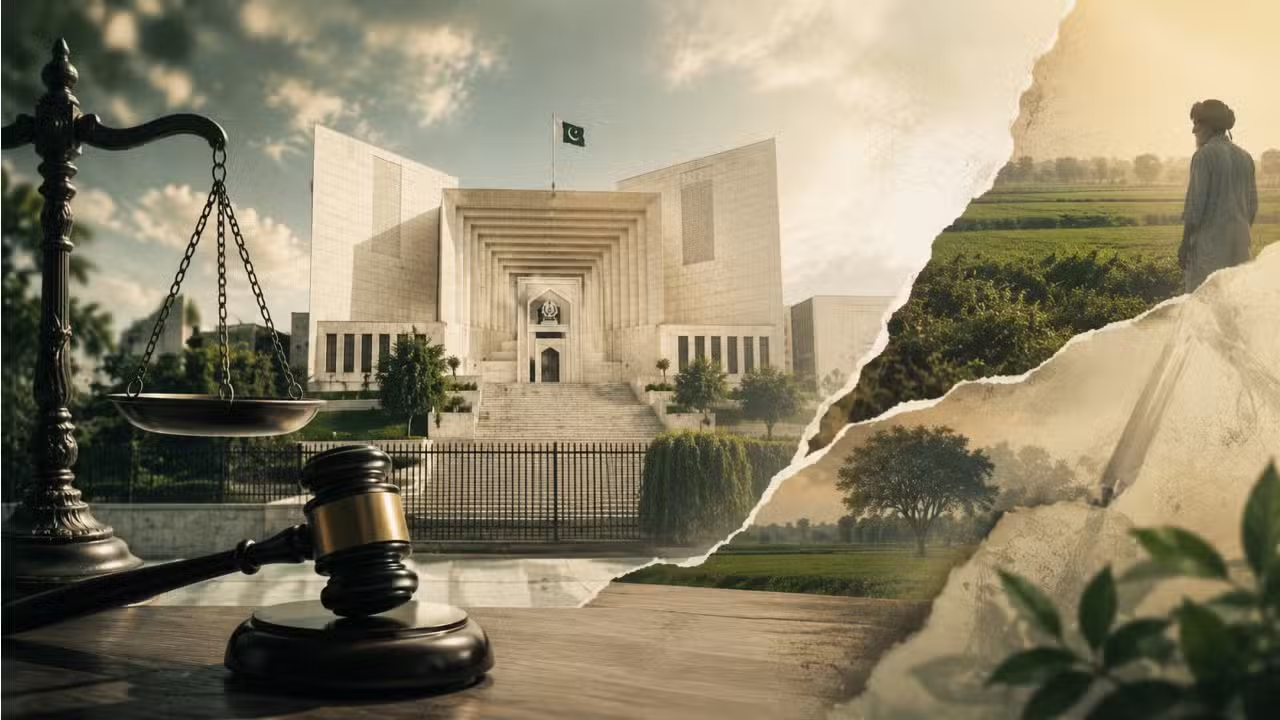
The Supreme Court of Pakistan has delivered a landmark ruling that strengthens the rights of landowners by declaring that governments must pay compensation based on the actual market value of land acquired for public projects. The judgment makes it clear that official government valuation rates alone cannot be used to determine fair compensation.
The decision came while hearing a series of civil appeals filed by the Khyber Pakhtunkhwa government in connection with a land acquisition dispute from Swabi. After reviewing the matter, the apex court dismissed all appeals and upheld the earlier rulings of both the Peshawar High Court and the Reference Court, which had ruled in favor of the affected landowners.
The detailed verdict was authored by Justice Muhammad Ali Mazhar, who emphasized that compensation should reflect the true market worth of the acquired property. According to the court, relying solely on the Deputy Commissioner (DC) rate does not always provide fair compensation because official rates may not accurately represent prevailing market prices.
The judgment reinforces the constitutional principle that private property cannot be taken without providing just and equitable compensation. It also highlights the importance of balancing the government’s development needs with the legal rights of citizens whose land is acquired for infrastructure and public welfare projects.
For many landowners across Pakistan, the ruling is expected to have far-reaching implications. In the past, property owners have frequently argued that compensation based on DC rates was significantly lower than the actual value of their land, resulting in financial losses when land was acquired for roads, housing schemes, dams, and other development initiatives.
By affirming that market value should be the primary basis for compensation, the Supreme Court has set a stronger legal standard for future land acquisition cases. The decision is likely to influence how provincial governments and acquisition authorities determine payments in similar disputes across the country.
Legal experts believe the verdict could encourage greater transparency in the land acquisition process while reducing conflicts between government agencies and property owners. Fair compensation may also help build public confidence in development projects by ensuring that affected citizens receive payments that accurately reflect the value of their property.
The ruling serves as an important reminder that public interest projects must be carried out in accordance with the law and with respect for individual property rights. As governments continue to invest in infrastructure and urban development, this judgment is expected to play a significant role in shaping future compensation policies and legal proceedings related to land acquisition in Pakistan.