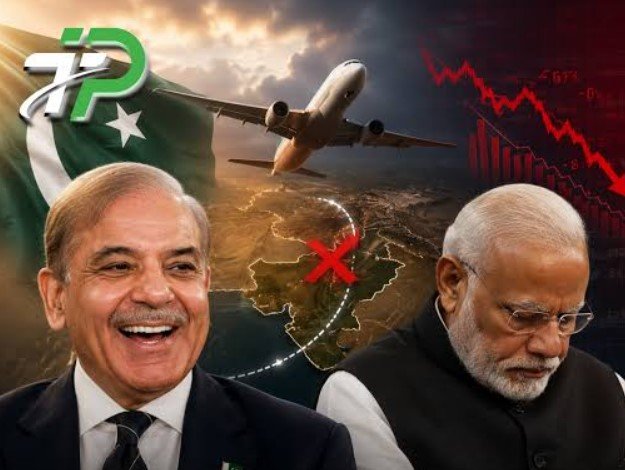
Indian airlines have reportedly suffered losses of around $2 billion as Pakistan’s airspace restrictions continue to force carriers onto longer international routes.
The estimate covers the prolonged period since Pakistan restricted its airspace to Indian-operated aircraft in April 2025.
However, the $2 billion figure should be treated as a reported industry estimate rather than an audited official loss figure.
Why Are Indian Airlines Facing Higher Costs?
Pakistan’s location provides an important westbound corridor for flights operating between northern India and destinations in Europe, North America and the Middle East.
With Pakistani airspace unavailable to Indian airlines, affected flights must use longer alternative routes.
Reported effects include:
- additional fuel consumption;
- longer flight times;
- increased crew and operating costs; and
- disruption to aircraft scheduling.
Flight times on affected routes have reportedly increased by anywhere from around 30 minutes to three hours.
Around 800 Flights Per Week Reportedly Affected
Reports estimate that around 800 Indian flights per week are affected by the airspace restrictions.
Approximately 640 of those flights operate through Delhi, making Air India particularly exposed because Delhi is a major international hub for the carrier.
Air India Cuts European Routes
Air India is making changes to its winter 2026–27 network.
The airline is suspending:
Delhi–Vienna from October 31
and
Delhi–Birmingham from November 1.
Air India is also reducing capacity on some other international services.
Industry reports attribute the network adjustments to a combination of higher jet-fuel costs, Pakistan airspace restrictions and temporary unavailability of Boeing 787 aircraft undergoing refurbishment.
Therefore, it would be inaccurate to attribute every route cancellation solely to Pakistan’s airspace ban.
How Much Is Air India Reportedly Losing?
Reports cited in Pakistan estimate Air India’s annual financial impact from the restrictions at approximately:
$455 million to $591 million.
The broader $2 billion estimate refers to India’s aviation industry and the cumulative impact of the restrictions.
These figures have not been independently verified through audited financial disclosures in the sources reviewed for this article.
How Long Will Pakistan’s Airspace Remain Closed?
Pakistan recently extended the restriction until:
November 24, 2026.
The Pakistan Airports Authority issued a new Notice to Airmen covering Indian-registered aircraft as well as aircraft owned, operated or leased by Indian airlines and operators.
The restriction applies to both the Karachi and Lahore Flight Information Regions.
How Long Has the Restriction Been in Place?
Pakistan and India imposed reciprocal airspace restrictions on each other’s airlines in late April 2025 following a sharp deterioration in bilateral relations after the Pahalgam attack.
Pakistan has subsequently extended its restriction several times.
For aviation purposes, the effect is straightforward: affected airlines cannot use the most direct routes through the neighbouring country’s airspace.
What Does It Mean for Passengers?
Longer routes can affect travellers through:
- longer journey times;
- fewer nonstop options;
- schedule changes;
- potential increases in airline operating costs; and
- changes to route frequencies.
Whether those extra costs translate directly into higher ticket prices depends on airline pricing and route demand.
Pakistan’s continuing airspace restriction is placing additional operational pressure on Indian airlines, particularly carriers operating long-haul flights from Delhi.
The total industry loss has been reported at around $2 billion, while Air India is also adjusting its European network as longer routings, fuel costs and aircraft availability affect operations.
The most firmly confirmed current development is that Pakistan’s airspace restriction remains in force until November 24, 2026, unless authorities announce another change.