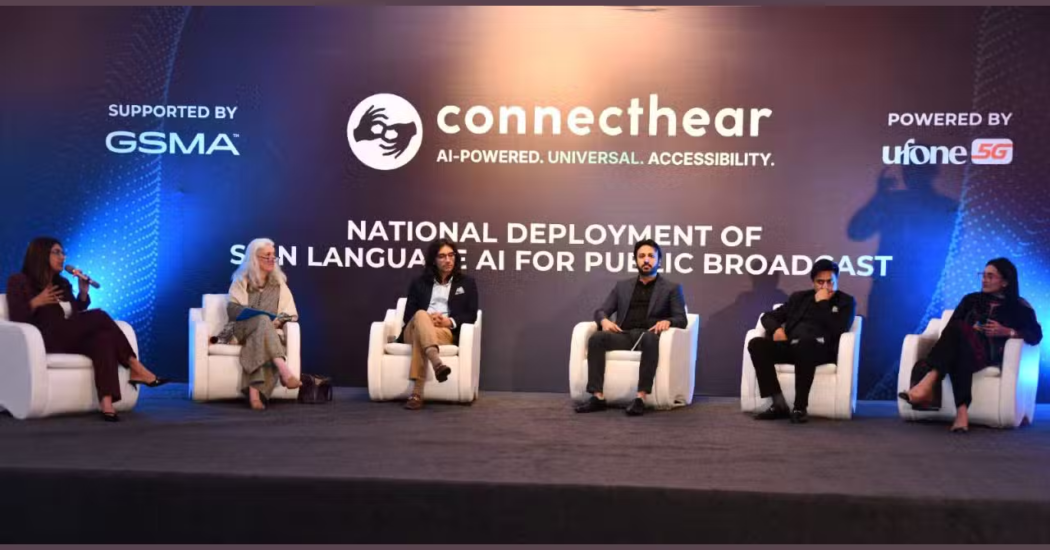
ConnectHear Expands Sign Language AI Nationwide in Partnership with GSMA and Ufone
ConnectHear has announced the nationwide rollout of its Sign Language AI system in collaboration with GSMA and Ufone, marking a major milestone in accessible communication technology for the Deaf community in Pakistan.
The announcement was made during the “National Deployment of Sign Language AI for Public Broadcast” event held at the Serena Hotel Islamabad. The gathering brought together representatives from government institutions, telecom companies, UN agencies, and humanitarian organizations to strengthen cooperation on inclusive communication systems at a national level.
The initiative also served as the closing ceremony for ConnectHear’s GSMA-supported Early Warning AI project, SUNO, which focused on delivering disaster-related information in sign language. The project is now transitioning from pilot testing to full-scale national deployment, signaling a shift toward more integrated accessibility solutions in public communication infrastructure.
During its pilot phase, SUNO reportedly reached nearly 2,000 beneficiaries across more than 10 disaster-affected districts in Sindh. The system was designed to function even in low-bandwidth environments, ensuring that Deaf individuals could receive critical emergency alerts during disasters. With the latest expansion, the platform is expected to extend its reach to over 50,000 users across the country.
The urgency of such initiatives is underscored by the fact that millions of people in Pakistan live with hearing disabilities, making accessible communication during emergencies a critical public safety concern. By integrating AI-powered sign language interpretation into broadcasting systems, the project aims to bridge long-standing communication gaps in disaster response.
International and industry leaders have also praised the initiative. British High Commissioner Jane Marriott highlighted the importance of inclusive, AI-driven solutions in strengthening disaster preparedness and ensuring equal access to life-saving information for persons with disabilities.
Similarly, Kimberly Brown emphasized that the project reflects a broader shift from pilot programs to scalable solutions capable of delivering real-world humanitarian impact. She noted that AI-based accessibility tools could set new global standards for inclusive emergency communication.
From the telecom sector, PTCL and Ufone representatives stressed the importance of leveraging nationwide networks to ensure that critical information reaches underserved communities. They emphasized that digital inclusion must go beyond connectivity to ensure equal access for all citizens.
ConnectHear co-founder Arhum Ishtiaq described the initiative as a step toward building technology that is inherently inclusive. He noted that the goal is to ensure that both digital platforms and physical communication systems become accessible to Deaf communities through AI-driven solutions.
The event also featured live demonstrations of AI-powered sign language broadcasting and showcased collaboration with organizations such as HANDS and DeafReach, which work in humanitarian response and Deaf education in Pakistan.
With its nationwide rollout, the SUNO initiative represents a significant step forward in integrating assistive technology into public communication systems, with the potential to improve disaster preparedness, emergency response, and everyday accessibility for Deaf individuals across Pakistan.
