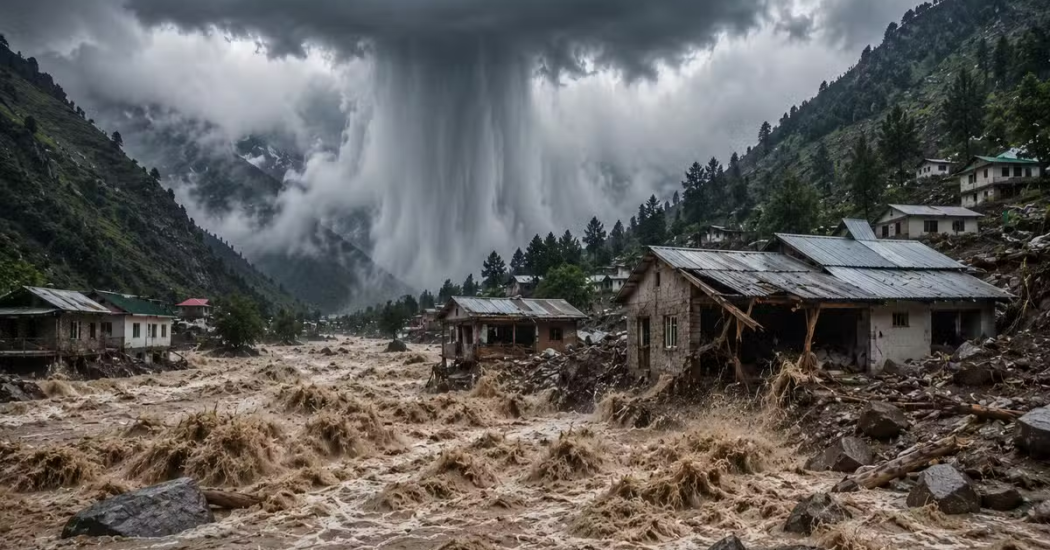
Fact Check: Did a Cloudburst Really Cause the Destructive Floods in Diamer, Gilgit-Baltistan?
Reports circulating on social media and various news platforms recently claimed that a powerful cloudburst in the Khanberi Valley of Chilas triggered devastating flash floods across parts of Diamer district in Gilgit-Baltistan. The incident was said to have caused extensive damage to homes, agricultural land, orchards, and road infrastructure, leaving several remote communities isolated.
According to the claims, the flooding affected multiple areas, including Khanberi, Manikal, Shahi Mahal, Bichi Nala, and Lainchar. Reports suggested that link roads connecting these villages were washed away, disrupting transportation and creating difficulties in the delivery of food and essential supplies. As images and videos of the destruction spread online, many users attributed the disaster to a cloudburst event.
However, the Pakistan Meteorological Department (PMD) has clarified the situation and challenged the widespread narrative surrounding the cause of the flooding.
In its official response, the PMD stated that there is no meteorological evidence confirming that a cloudburst occurred in the affected region. The department explained that while the area did experience significant rainfall, the weather data collected from available monitoring stations did not indicate the occurrence of a cloudburst, which is a highly localized and intense weather phenomenon characterized by an extremely heavy amount of rainfall within a short period.
Meteorological experts emphasized that flash floods can develop due to a variety of factors, including prolonged rainfall, rapid runoff from mountainous terrain, and seasonal weather patterns. In northern regions such as Gilgit-Baltistan, steep valleys and rugged landscapes can amplify the impact of heavy rain, causing streams and water channels to overflow even without a cloudburst.
The clarification from the PMD highlights the importance of relying on verified scientific assessments during natural disasters. While the destruction reported in Diamer remains a serious concern for local communities, officials caution against spreading unverified claims regarding the exact cause of such events.
The flooding reportedly damaged residential properties, standing crops, fruit orchards, and transportation links, affecting daily life in several villages. Local authorities and emergency responders have continued efforts to assess losses and restore access to affected areas.
The incident has also reignited discussions about climate-related challenges facing Pakistan’s northern regions. Experts warn that changing weather patterns, glacial melt, and extreme rainfall events are increasing the risk of floods and landslides in mountainous areas, making accurate weather monitoring and disaster preparedness more important than ever.
As investigations and assessments continue, the PMD’s statement serves as a reminder that natural disasters should be evaluated using verified meteorological data rather than assumptions circulating online. While the floods caused significant hardship for residents of Diamer district, the available evidence does not currently support claims that a cloudburst was responsible for triggering the disaster.
