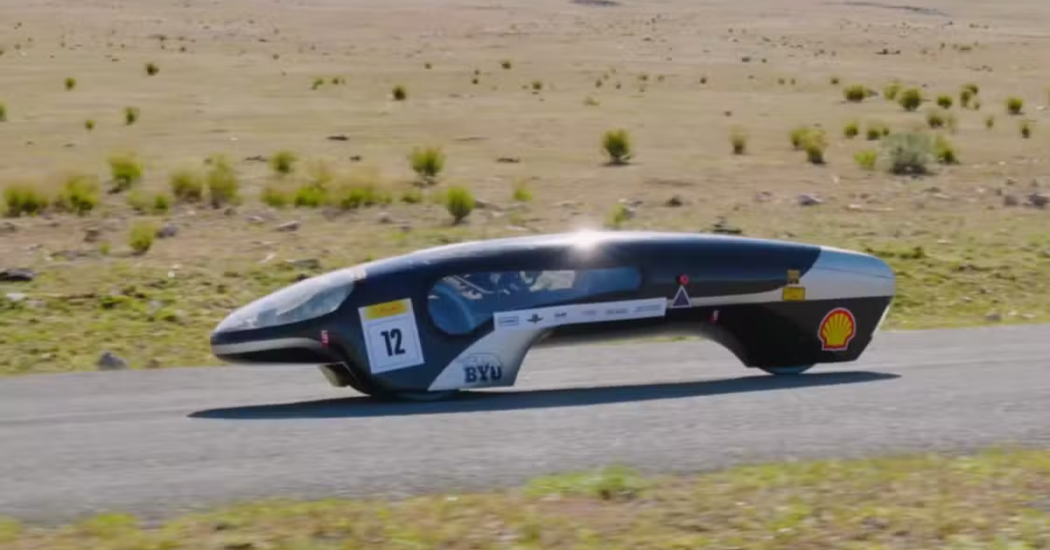
A group of engineering students in the United States has achieved an impressive milestone in fuel efficiency by developing an experimental vehicle capable of traveling approximately 912 kilometers using just one liter of fuel.
The innovative vehicle, known as Supermileage, was designed and built by students at Brigham Young University. The project was created for the renowned Shell Eco-marathon, an international competition that challenges student teams to design vehicles capable of covering the greatest possible distance while consuming the least amount of fuel.
The achievement highlights the growing role of student-led innovation in advancing sustainable transportation technologies. By focusing on efficiency rather than speed or performance, the team demonstrated how engineering design can dramatically reduce fuel consumption.
The Supermileage vehicle was specifically engineered to minimize energy loss through lightweight construction, aerodynamic design, and highly efficient mechanical systems. Every component was carefully optimized to maximize the distance traveled from a minimal amount of fuel.
Competitions such as the Shell Eco-marathon encourage students to explore real-world solutions to global energy and environmental challenges. Participants from universities and educational institutions worldwide compete to push the boundaries of fuel efficiency and sustainable mobility.
While experimental vehicles like Supermileage are not intended for everyday road use, the technologies and design principles developed through these projects often contribute to future advancements in the automotive industry. Innovations in aerodynamics, lightweight materials, and energy management can eventually influence commercial vehicle development.
The reported fuel economy of approximately 912 kilometers per liter is significantly higher than that of conventional passenger vehicles, showcasing the potential of specialized engineering approaches when efficiency becomes the primary objective.
Student projects such as this also provide valuable hands-on experience in mechanical engineering, automotive design, manufacturing, and problem-solving. Participants gain practical skills while contributing to research and development efforts focused on reducing energy consumption.
As the global transportation sector continues to seek cleaner and more efficient solutions, initiatives like the Shell Eco-marathon serve as important platforms for nurturing the next generation of engineers and innovators.
The success of the Brigham Young University team demonstrates how creativity, technical expertise, and collaboration can lead to remarkable achievements in fuel efficiency. Their accomplishment not only earned attention within the competition but also highlighted the possibilities of future transportation technologies designed with sustainability in mind.
With growing interest in energy conservation and environmentally responsible mobility, projects like Supermileage continue to inspire researchers, students, and industry leaders to rethink what is possible in vehicle efficiency.