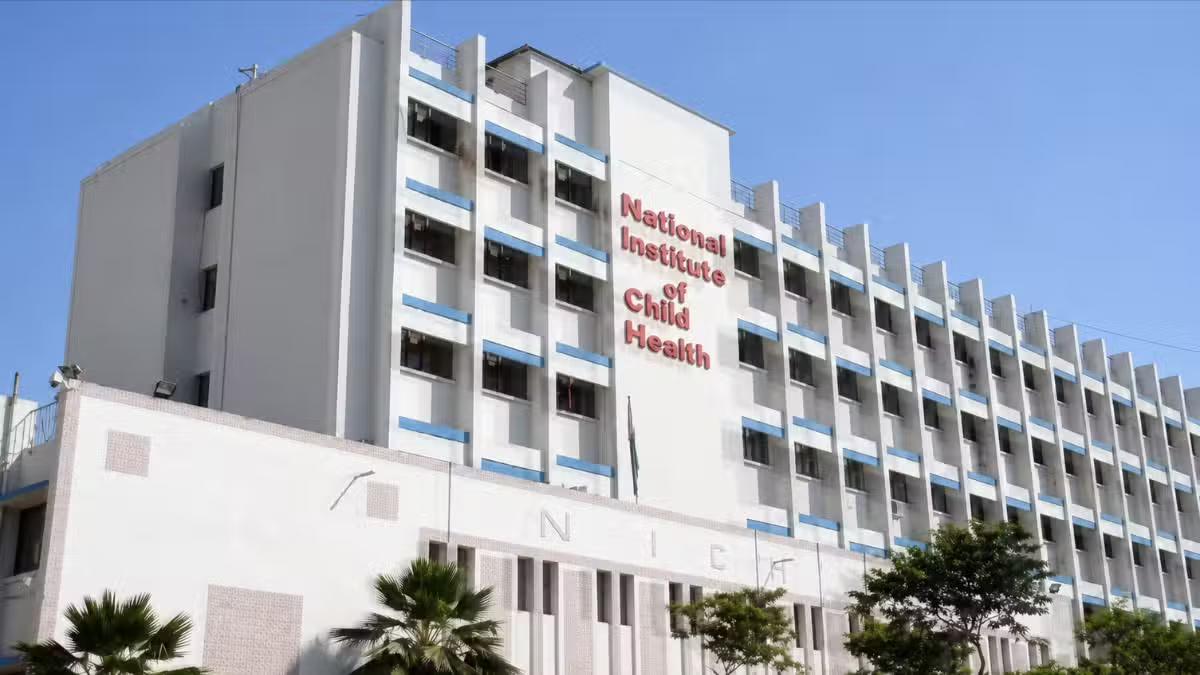
The Sindh government has approved the construction of a new 13-story medical tower at the National Institute of Child Health (NICH), marking a major planned expansion of healthcare infrastructure for children in the province.
The proposed Bilquis & Abdul Sattar Edhi Medical Tower will have a capacity of 445 beds and will be developed at NICH under a public-private partnership with the Abdul Sattar Edhi Foundation.
The total estimated cost of the project is $17 million. Under the approved financing arrangement, the Abdul Sattar Edhi Foundation will contribute $10 million toward construction, while the Sindh government will provide $7 million as a grant-in-aid.
The provincial government’s financial contribution will be released in two equal installments. The first installment is planned for the 2026-27 financial year, while the second is scheduled for 2027-28.
The project is expected to expand the healthcare capacity available at NICH, one of the key public-sector institutions providing specialized medical services to children in Sindh.
The addition of a 13-story facility with 445 beds would provide significant additional space for patient care and other hospital-related services. The project’s scale also reflects the need for expanded healthcare infrastructure at major public hospitals.
The public-private partnership model will bring together government funding and philanthropic support from the Abdul Sattar Edhi Foundation. The foundation’s $10 million contribution represents the larger share of the project’s total financing.
The Sindh government, meanwhile, will meet the remaining cost through its grant-in-aid contribution. Releasing the amount over two financial years will allow the provincial authorities to allocate the funds through the relevant annual budgets.
The proposed tower has been named after Bilquis Edhi and Abdul Sattar Edhi, whose humanitarian work is closely associated with healthcare, welfare and emergency services in Pakistan.
For families seeking specialized medical care for children, additional hospital capacity can be particularly important as demand for pediatric healthcare services continues to grow.
The project also represents another development in the use of public-private partnerships for healthcare infrastructure. Such arrangements can combine public-sector resources with private or philanthropic financing to support the construction and expansion of medical facilities.
Once completed, the new tower will add substantially to NICH’s physical capacity. The exact timeline for construction and the range of services to be housed in the building will depend on the project’s implementation and subsequent development stages.
The approved funding arrangement provides a defined financial framework for the project, with the Sindh government’s $7 million contribution divided equally between the 2026-27 and 2027-28 fiscal years.
The approval of the Edhi Medical Tower is therefore a significant step toward expanding pediatric healthcare infrastructure at NICH. Further details about construction milestones, facilities and operational plans are expected as the project progresses.