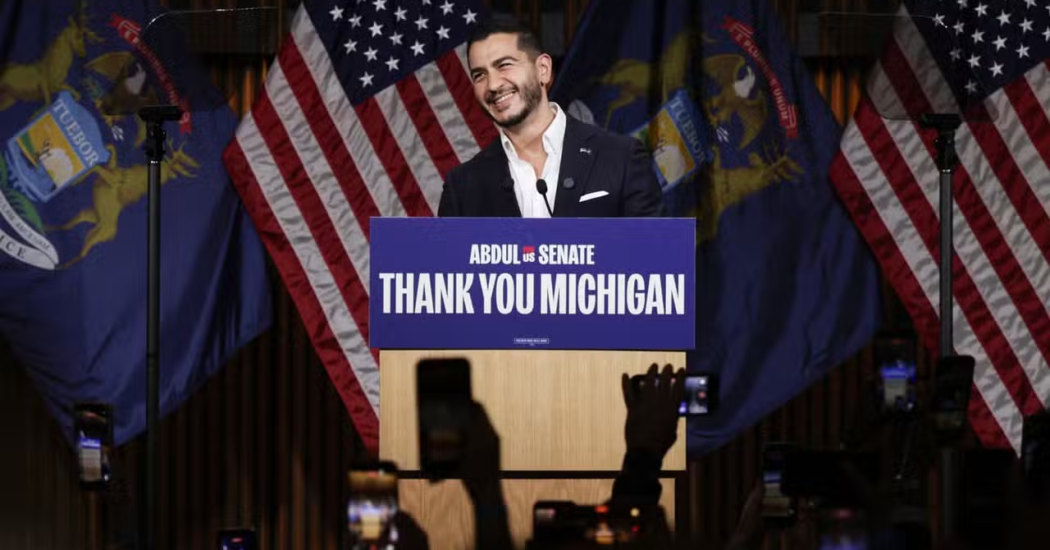
Newly elected United States Senator Abdul El-Sayed has called for an end to unconditional American military assistance to Pakistan and several other countries, including Israel, Egypt, Jordan, Saudi Arabia and Qatar. His remarks have attracted attention in Pakistan because of the country’s longstanding defence and security relationship with Washington.
El-Sayed shared his position during a public town hall titled “Students vs. Billionaires”, held alongside Senator Bernie Sanders at the Michigan Theater in Ann Arbor on October 26. He argued that American taxpayers’ money should be directed towards domestic priorities rather than providing weapons and military assistance to foreign governments without conditions.
During the discussion, the Michigan Democrat said he wanted to prohibit unconditional foreign military aid for every country receiving such assistance. He specifically mentioned Pakistan among the countries that should be covered by the proposed policy.
El-Sayed also questioned why American taxpayers should finance weapons and military equipment for other nations when the money could instead support education and other public services within the United States.
His position is based on the argument that government resources should prioritise domestic needs, including better schools, healthcare and economic opportunities for American citizens.
The senator-elect’s comments have become particularly relevant following his victory in the November 3, 2026, US midterm elections. He defeated Republican candidate Mike Rogers in Michigan’s Senate race, securing a historic political achievement by becoming the first Muslim elected to the United States Senate.
His election has brought additional attention to his foreign policy positions, particularly his views on American military assistance to international partners.
For Pakistan, the remarks are significant because military cooperation has remained an important part of its relationship with the United States. Over the years, Islamabad has received American military equipment, financial assistance and security-related support through different programmes and bilateral arrangements.
However, US-Pakistan defence cooperation has also experienced periods of uncertainty, with military assistance previously suspended or restricted amid disagreements over security policies and regional developments.
El-Sayed’s proposed approach could add another dimension to discussions about the future of American assistance if similar ideas gain support in Congress. His position suggests that foreign military support should not be provided automatically and should instead be subject to stricter conditions.
Importantly, his comments do not represent an enacted US government policy. A single senator cannot independently terminate military assistance to Pakistan or other countries. Any significant change would require action through the appropriate legislative and government processes.
As an incoming member of the Senate, however, El-Sayed will have opportunities to participate in debates and votes concerning foreign assistance legislation. He could also advocate for amendments that introduce additional conditions on military funding and weapons transfers.
The senator-elect has also maintained that his position applies equally to all countries receiving unconditional American military support. By including Egypt, the country from which his family immigrated, alongside Pakistan and other nations, he presented the proposal as a broader foreign policy principle rather than a measure targeting one particular country.
His remarks reflect an ongoing debate in American politics over how public funds should be allocated between domestic programmes and international military commitments.
For Pakistan, the potential implications will depend on whether proposals to restrict unconditional foreign military assistance receive broader political and legislative support in Washington. Until then, El-Sayed’s statement should be understood as his policy position rather than an official decision to stop American weapons supplies to Islamabad.
The issue is likely to remain relevant as the newly elected US Senate prepares to take up its legislative responsibilities in January 2027 and considers future foreign policy and defence spending priorities.